

|
|
Popular
Russian print magazine 'Game.exe' published a huge six
page interview with Jonathan Boakes in Spring 2006, the article featured
illustrations from the up and coming adventure game 'The Lost crown: a
ghosthunting adventure'. Some of the images were exclusive to Game.Exe.
Click a thumbnail image above to view the larger preview, or, scroll down
for a complete English translation, complete with illustrations. |
 |
JonathanBoakes:
My name is Jonathan Boakes, I am the head of Darkling Room (previously
XXv Productions), a digital media outfit based on the coast, in Cornwall,
UK. Some may know my previous games, like Dark Fall, a supernaturally
themed adventure game from 2003.
Game.Exe: "I’ve been playing F.E.A.R. and Splinter Cell: Chaos Theory, both games are thought to be ‘as good as it gets’, but I still feel we are missing out on something, which was lost last century" – we’re very excited by these words of yours, Jonathan! What have disappeared from games of our days and from adventure games in particular? JonathanBoakes: Charm. It seems completely missing from the huge game releases we have now. There seems to be a theory, promoted by publishers, that the bigger, more expensive a game is, the better the gameplay experience. It’s not true. I believe the ‘homemade’ adventure games made between 1980-2000 were enjoyable in their smallness, and quirky style. A game with rough edges, and less glossy production values (and PR!) invites gamers into the production, whereas a highly robust, glossy game can be hard to penetrate, and love. Although I enjoy playing the big releases, I am constantly surprised how quickly I forget them. Game.Exe: Excuse us for yet another quote: "…the fact is that the developers are more willing to make press releases, talk about their games and expect some recognition than make game itself". The best thing that we’ve heard lately! What ways of escaping from such a situation do you see? What can bring second life to such a dull life of game developers? JonathanBoakes:
I don’t understand the question. Dull life? It’s the best
job in the world! I think the quote is from a Spanish
interview, and fear something may have been ‘lost
in translation’. I was pointing out that indie developers are
much braver, in the current period, and are willing to promote their
games, rather than hide away, and hope someone finds it. Being an indie
developer is not embarrassing; it is liberating, and great for an industry
struggling to find new ideas. |
 |
Game.Exe:
The creation of Dark Fall game – one of the key adventure titles
of our days – it a very interesting story. You had a chance to move
from own way of distribution of the game to a contract with The Adventure
Company... what did this experience give you, as a developer? Is there
any chance for a ‘nutty professor’ to build a game alone,
deliver it to the shelves and sell enough copies to continue his/hers
nutty work? What ways do you see in finding a compromise between an indie-development
and the interests of the suits? All in all, your relations with TAC can’t
be called that friendly and warm…
JonathanBoakes:
A production by a single individual, like your ‘nutty professor’,
is very possible. It takes bravery, and a little madness! I found self-publishing
Dark Fall (to all corners of the globe) very enlightening, and entertaining.
A strong bond was formed with the gamers themselves, which large-scale
store publishing cannot achieve. The cd’s of Dark Fall were burnt
on my home computer, packaged by my own hands, and carried to the post
office twice a day. It was at this time that The New York Times claimed
“Dark Fall outshines the rest of this years commercial adventure
games”, other major reviews were also published at this time.
This process continued for a whole year before the publisher (“the
suits”) became interested. By that time I had stopped getting
large orders, and was ready to hand the distribution to someone else.
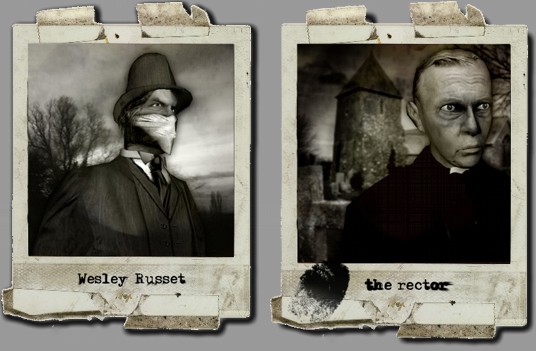
My role was finished, and I moved onto producing another game. JonathanBoakes: ‘Lovecraft’ is recognized as one of the worlds best supernatural story tellers, and has been adapted many times for screen, and games. For example, Call of Cathulu is currently available for Xbox. Dickens, Doyle, James and Du Maurier have been less well served, and I felt a smaller production (like The Lost Crown) would be a great place to explore many of the themes explored in their short stories. You mention ‘Rebecca’, which is one of Du Mauriers best-known novels. It’s a huge book, and very famous, so I am less interested. The smaller, darker, tales like ‘The Old Oak Tree’ or ‘The Endless Steps’ are much more appealing. The short story format enables many ‘serious’ writers to have a bit more fun, and explore themes they would otherwise not be able to tackle. Charles Dickens ‘The Signalman’ is recognized (by some) as the best short ghost story. Ever. GameExe: Eastern coast of the UK is the best place for the story of yours to unfold. By the way, speaking about Great Britain – what can you tell us about Peter Straub’s ‘Ghost Story’? Will you place his name amongst the names mentioned above? JonathanBoakes: Firstly, I should point out that ‘Ghost Story’ is set in New York State, and not England’s coastline! ‘Ghost Story’ is a typically derivative ghost story, and full of clichés from classic supernatural fiction. Straub acknowledges the influence of Henry James, but fails to recognize that it is the writing of M.R.James, more than anyone else, who influences his narrative. The theme that something nasty occurred in the past, and will come back to haunt the characters, is directly connected to stories such as ‘A Warning to the Curious’. Straub’s style is ‘would-be classic’, with highly recognizable elements from classic fiction. So, including Straub’s work as an influence would be rather pointless, as I too am attempting to update the classic ghost story. Game.Exe: In one of your interviews, you have stated that The Lost Crown is a dedication to well-built short stories about the supernatural. What did you have in mind while giving your game such a description? JonathanBoakes: I believe that the short story is the best medium for telling ghostly tales. There is something wonderfully compact, and matter of fact, in the writing by James and co. The stories could almost be described as ‘case-files’ rather than stories, and exhibit a need to document a possible haunting, rather than describe it. More often than not, the haunting will focus on a single individual, much like my screenplay for The Lost Crown. I hope to achieve the short story style by dividing the game into chapters, set over 4 days. Each day will present unique and compact supernatural mysteries to explore, record and solve. |
 |
Game.Exe:
What differences will you name while comparing your current game with
the ones that have shipped already? The synopsis has the same determinations
as usually – ‘scary’, ‘inspired by classical ghost
stories’ etc… Well, Jonathan, we’ve heard these words
already!
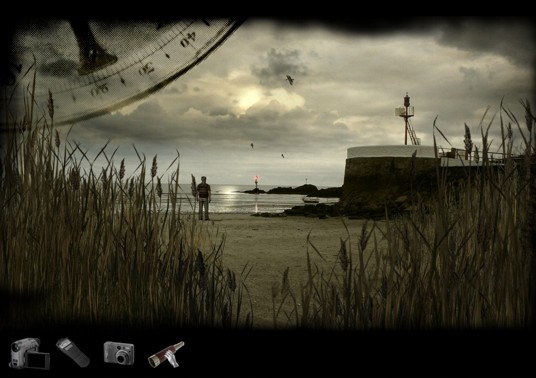
JonathanBoakes: My previous games have been very different, to both The Lost Crown, and each other. Dark Fall 1 was intended as a ‘Blair Witch’ style ghosthunt set in a small, claustrophobic setting. The horror was faceless, and ancient. Whereas Dark Fall 2 had a much larger play area, set in 3 different time periods, and featured a sci-fi conclusion. Both the previous games were 1st person perspective, player driven stories. The Lost Crown is presented in 3rd person, and features a cast of virtual actors. The story will explore how ghosts are interrupted in our modern, rational, world, and how the supernatural has become commercial, and lures tourists to dull towns who have forgotten their history, and soul. The ghosts are still there, unrecognized, until you go looking for them. Whether or not they are friendly, is another matter. Game.Exe: And what are those things that drag you to scary stories, what’s the catch? Why them? And let us forget just for a second about adventure stereotypes and usual standards (and we do know that they are not the key!)… JonathanBoakes: A belief in the supernatural and a fascination with restless souls has always featured in my creative work. Beyond exploring the ghost story, I am also interested in pagan history, a forgotten connection with the landscape around us, and the clues left us by the ancients. Modern, post consumerist existence can be very sterile, and soulless, so I hope to rekindle some interest in the unknown, the soulful and melancholic nature of life and death. In doing so, many scary events can unfold, and mysteries can be explored, and even solved. Game.Exe: Ghost hunting is plot that unfolds with greater dynamics. What will be the internal rhythm of your upcoming game? What will stay in it having its roots in Dark Fall’s slow way of storytelling? JonathanBoakes: I have tried, in the past, to make my ghosts sympathetic. I like to believe that those who were good in life, continue to be good in death. The Hollywood ideal that death creates monsters from the living is very entertaining, but rather transparent. A fear of death itself promotes those stories, whereas I prefer to believe in an afterlife not populated by zombies, witches and horrors. Of course, there are very nasty elements to fear, when exploring the supernatural, and The Lost Crown will provide plenty of scares, and frightful fiends. It will be up to the player to separate the evil spirits from those trying to help, or move on into the afterlife. Many of the ghosts have very sad stories to tell, and it is they who will dictate the pace, and dynamic, of the game. Game.Exe: All of those hi-tech devices, licensed ghost trackers and the like… Do you really think that ‘realistic’ things will enrich the atmosphere? Won’t they kill the original Dickens’ spirit which has nothing to do with the results of the progress? JonathanBoakes: As far as I am aware, Dickens’s did not believe in ghosts. They were used (often in his Christmas stories) to explore his fears, and the moral questions presented in life. Like all proactive Victorian gentlemen, Dickens would have been interested in the science of the supernatural, and encouraged research into the cause of such phenomena. Our modern ghosthunting gadgets are extensions of devices long thought to be useful in this field. The EMF Meter, which measures changes in the magnetic forces around us, is really an update of the humble compass. Ghosthunting is currently very popular, and is matched by the interests of the Victorians in such things. The 20th century saw a massive decline in this interest, due to the World Wars. Victorian ghosthunters were just as keen (as we are), to expose the fake séances and dodgy ouijaboards, but to also locate the real ghosts and haunted locations. |
 |
Game.Exe:
Can we treat your game as the confrontation of ‘irrational’
and ‘rational’? If yes, why do you show sympathy to the irrational
and not the rational? Do you see a real threat in the hi-tech society
that is building with each day that comes by?
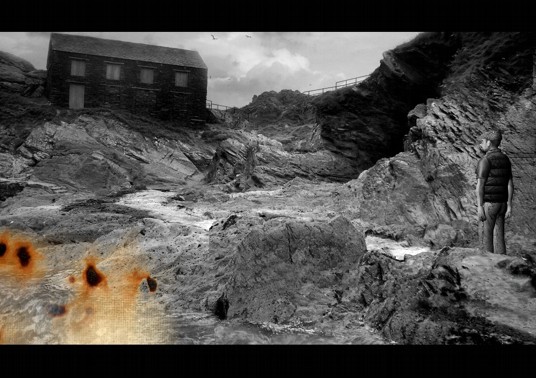
JonathanBoakes: Technology doesn’t threaten me at all. It has enabled me to create my games, and explore the world around me. I see technology as a way to further research into the supernatural, and also disprove fake psychics and charlatans. It is only in recent history that we have discovered bacteria, viruses and the smallest animal kind via the microscope. Before the microscope, we did not know of their existence, but were able to observe the mysterious effects they had on the world around us. I strongly believe that technology will be invented to prove the existence of ghosts, or locate the human soul. What excites me the most, is that idea that the irrational can become the rational through science, and technology. This theme will be explored in The Lost crown. Game.Exe: Going back to realism: what can you tell us about the percentage of photorealistic backgrounds, precisely created cold landscapes of the UK or we will see GB as a more gothic-styled country as described in many and many literature pieces (and which has nothing to do with the original England)? What is the balance of real and light romantics of fiction? JonathanBoakes: Gothic, romantic, realistic, and fantastical. It’s going to be very mixed! The style of the artwork will depend entirely on the location. There are several changes in mood, style and tone, to reflect specific locations. For example, the eerie ‘fenland’ of East Anglia is a lonely, desolate but powerful landscape. This area is depicted quite realistically, in ochre tones, and huge moody skies. Whereas the gothic church at ‘Northfield’ is depicted as cold, stony and monochrome, with jet-black crows puncturing a wintry sky. With this location I am attempting to evoke the spirit of the old black and white Hammer Horror and Universal films, where actors filmed against stark painted landscapes, and backdrops. It is stylized location, and not meant to appear too realistic. Game.Exe: One of the most intriguing moments: what will be the basis of the in-game puzzles? Taking in mind the specifics of your game and the storyline… the imagination of ours draws fantastic pictures! We would be happy if you share a couple of examples of your game’s puzzles with the details – what and why. JonathanBoakes: The daytime activities, in The Lost Crown, will include efforts to locate possible haunted locations. Ghosts don’t exist everywhere, so some skill is needed to locate them. Talking with the older people of the town, and exploring the archives and museum will unearth strange stories worthy of investigation. You will travel to these places, and use your ghosthunting gadgets to seek paranormal activity. If successful, you will return to that location at night, when the location seems less familiar, and far scarier. An example of a specific puzzle would be the theft of an item from the local museum, which you need for research. CCTV cameras watch all the display cabinets, and you need to steal an important item. Using a few objects from your inventory, you will construct a clever way to fool the camera into thinking it is seeing an empty room. Once accomplished, you can grab the precious item, with no-one to stop you! Naughty, but very essential. Game.Exe: What did happen to The Lost Crown after your previous works from the point of technologies? Are you going to feature a full-scale soundtrack? The technological background of your game is of interest for us, thus, spill some tech-beans, please. JonathanBoakes: A full soundtrack is being composed as I type this answer. The Lost Crown is a filmic style adventure game, and this is reflected in the music. Locations are enhanced with unique musical arrangements, featuring fragile violins and deep resonate bass tones. It has been an absolute pleasure to compose elements of the soundtrack, as the process is new to me. Another new process is building game scenes for a 3D character. I’ve not tackled this aspect before, and it has been fun to re-build the world around me for the virtual actors. The art of the game scenes is a montage of the real (photographic) and the created props, dressing and actors made in 3D. I look upon each scene as a film still brought to life. You could say the effect is very much like a stage play, where the scene change is obvious, and theatrical. |
 |
Game.Exe:
Do you see The Lost Crown as a stand-alone story, a finished one or, like
it happened with Dark Fall, the success of the game can provoke the sequel
to happen? How do you personally treat adventure serials?
JonathanBoakes: I am not thinking beyond The Lost Crown at the moment. I have a lot of work still to do, but it would be fun to create another 3rd person game at some point. I have build lots of characters, so it may be productive, and interesting, to use them in a future adventure. Perhaps I should think about the game as the start of a movie-style series. After ghosts, our heroes could explore themes like UFO’s, the undead or vampire cults! Hmm, or maybe not! Game.Exe: We’ve heard that some of the development team members have participated in paranormal studies. Is that true? Can you, please, tell us more about this as we like devoted people very much! JonathanBoakes: Yes, both myself, and the team, have been to real paranormal investigations. Ghosthunts! It was important, if featuring real ghosthunting techniques, to know how they work, what happens, and what sort of people partake in this very unusual hobby. I have yet to be convinced that ghosts exist, but I have seem some very strange things, and heard voices from somewhere not of this earth. When alone in the dark, with a night-vision camera for eyes, you can imagine all sorts of horrors, and scary phantoms. Ghosthunting is a vivid, and unique, experience, which can change your beliefs for good, and bad. Anyone interested to read some of our investigations, and view possible photos of the supernatural, can visit www.thishauntedland.co.uk. Game.Exe: The list of people that are now working on your The Lost Crown a number of guys that have theatrical background! It is hard to imagine a better field of work as a canvas of an adventure game. But do you really think that the audience is ready for it? Will it receive such a cross-cultural project these days when even adventures with huge budgets are having problems? JonathanBoakes: To be brutally honest, the commercial viability, and potential success, of the game is the last thing I think about. Obviously, I would be stupid to create something that was unplayable, or unpopular, but it isn’t my main motivation. Making thousands of dollars from the project is also less important, but people do need to be paid, and life is increasingly expensive. With The Lost Crown, I believe we have created a lively, and unique looking game to the best of our ability, and will complete the venture on time, and within budget. The size of the budget is important, but our dedication, and common sense is far more vital to get the job done. Adding an element of theatricality to the gameplay has been refreshing, and fun. Ghost stories are allowed to be dramatic, and slightly OTT, so we are enjoying the freedom the medium provides. There are no truly silly elements, but the scares will be scary, and the atmosphere will be thick with menace. Game.Exe: Jonathan, thank you very much for your answer and time dedicated to answering our questions. We’re closing watching the development of The Lost Crown, thus, please, be sure to keep us updated. Meanwhile,
keep up the good work! |
|